Synopsis–
Earth, Speak by Morgan Talty is part of a larger collection of short stories from Talty’s book, Night of the Living Rez, which follows the character of David living on a reservation and the repercussions of colonial trauma on the Penobscot Nation. Earth, Speak has a powerful atmosphere of isolation and struggle, all intertwined in the imagery, dialogue, and setting of the story, leaving an immersive and memorable effect on the reader. Talty, being Penobscot himself, uses David to bring to life the real problems of identity, substance abuse, and survival as a result of hundreds of years of oppression, and explores themes of restoration and reclaiming of identity.
Promotional Blurb: Walt Whitman-
Morgan Talty does not stay quiet! I am greatly moved by the persistence of the Penobscot spirit, and as civil unrest persists among the American people voices such as these have never had more value. I read the unfolding life of a boy, as American as the rest, yet reaping the consequences of hatred imposed on him from his civil brothers. This story represents but one leaf in the field of tales from the indigenous people on their oppression, Talty’s contribution being one of sophistication and honesty which has a lasting impact in its place of things. I highly recommend it.
Promotional Blurb: Nathaniel Hawthorne-
Earth, Speak is Morgan Talty’s generational folk tale of Native American oppression. Othering in this country has left us divided and in need of stories like these. As we follow Talty’s character, David throughout his journey there unfolds a life touched by loss of identity, substance abuse, and isolation which details just how the actions of hate have left a whole people divided. In a world where good and evil are confused, let us celebrate Talty’s voice and the power he gives to those who were left without a voice.
Designers Statement–
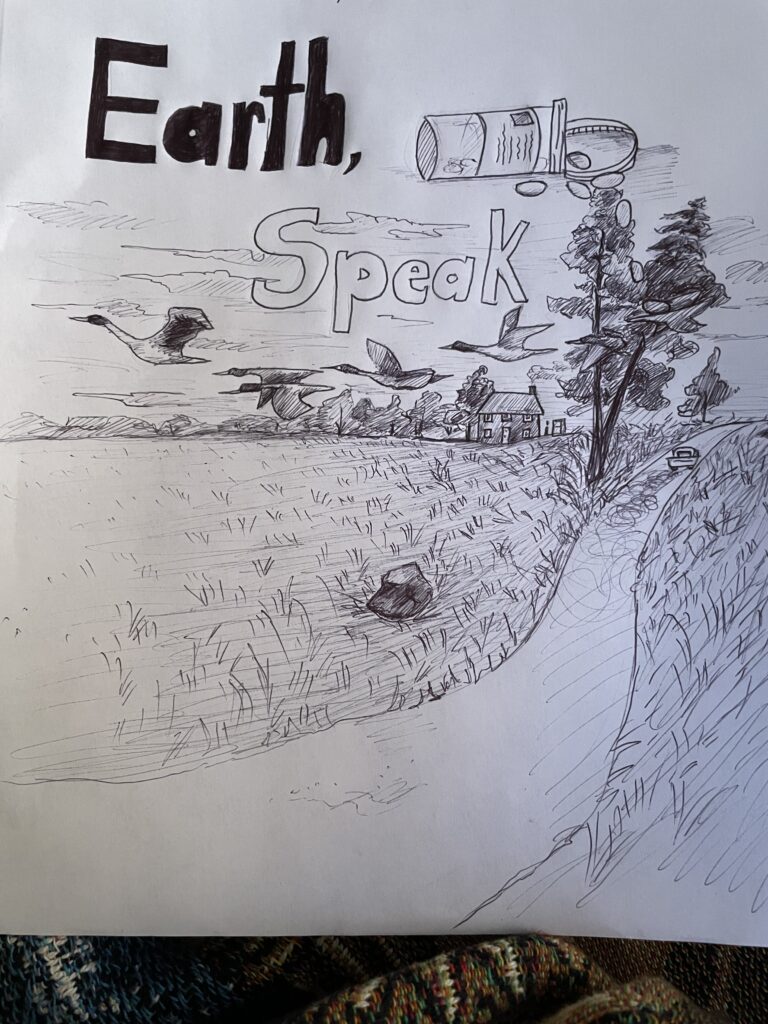
I drew the opening scene as I imagined it, where Fellis and David are driving to Darly’s house down a long dirt road. It’s morning and foggy, which I tried to represent with extra low clouds that are wispier. The morning is peaceful and quiet, which contrasts with the fast-moving truck (which can be inferred by the dust left behind), showing a disconnect between nature and the boys. In the truck are two members of the Penobscot Nation so this disconnect can be interpreted as the disconnect from native peoples and their native land, which loses the culture with it. David and Fellis are out of sync with the harmony of the world, which was quintessential to indigenous culture and shows a repercussion of colonization. The fog is also significant to the story and represents themes of isolation and feeling lost, without identity. A few times characters in the story describe their heads as feeling foggy, a typical symptom of substance abuse which they experience. Substance abuse could be considered a symptom of oppression as it ends up being a common coping mechanism for the depression colonization left the squandered culture in. As the characters numb their problems with substances however, they also feed back into the loop of fog and isolation, furthering themselves away from restoration of their culture. However, the fog is also not deep, there is hope for the boys to drive out of it yet.
In the image David and Fellis are driving to Daryl’s house, Darly’s small figure can be seen in the distance standing by the outhouse where they find him in the story. The truck has already passed a large boulder in the middle of the field, leaving it behind in the dust from the road. I included the boulder as David interacts with one on the reservation later in the story which was placed representing the ceremonial land they were on. David did not understand the significance of the boulder then, just as it appears he ignored it in the drawing. I included the boulder in this image despite the incorrect setting, specifically behind the truck to be ignored by David and Fellis. It represents the left behind and forgotten Penobscot identity, hidden in the land but easily overlooked. David and Fellis are not even aware of the significance of the land they drive on, and the impacts of their own oppression happening around them. Yet the boulder stands firm and unmovable, there for David to pass by later serving as a reminder of the culture and land he is a part of.
Another element of the drawing is the pill bottle tipped over, transforming into geese. Substance abuse, specifically that of prescription drugs is a major theme in Earth, Speak as it is typically a consequence of colonization in indigenous communities. David, Fellis, and Darly all struggled with addiction of some kind. In the story, David goes through withdrawal which helps him overcome his addiction in the end. During this process he is able to make connections with people and begin to break the destructive patterns that addiction has had in his life- including reconnecting with his cultural identity and family. The tipped over pill bottle is meant to represent the substance use- but also the breaking of cycles. Geese transform from the pills, representing the transformation David begins with the ceasing of the pills. There was no specific imagery of geese in the story, but they have always had a connotation with freedom for me (mostly because of the poem “Wild Geese” by Mary Oliver), and especially the free spirit of the wild. Geese feel free to be as loud and in as much of the way as suits them. So, after hundreds of years of oppression it seemed fit geese would represent the reclaiming of indigenous identity, unapologetically loud, in nature, and free.
How the title of the story was written on the book cover was also meant to be significant. Specifically, the word “Earth” is colored black, representing the “scorched earth” phrase. The phrase refers to a military tactic to take no prisoners and leave the land completely decimated, destroying everything in its path. This is relevant to Talty’s story as “scorched earth” is a good way to describe what happened to the indigenous culture and peoples of America, and by extension the Penobscot Nation. This story is all about the daily consequences and their quiet impacts. A completely decimated land may be hundreds of years in the past, however the people impacted then are still impacted now. So, I added that final element as one last reminder of the people who were originally affected and how it created a trickled down effect, into what is seen in Talty’s stories.
References–
Talty, Morgan. “Earth, Speak.” Night of the Living Rez, 5 Jul. 2022. Accessed 15 Apr. 2026
Goddard, Author Taegan. “Scorched Earth.” Political Dictionary, 19 Mar. 2026, politicaldictionary.com/words/scorched-earth/. Accessed 15 Apr. 2026.
